
Article No. 2 — Event Organization and Management from a Professional Perspective
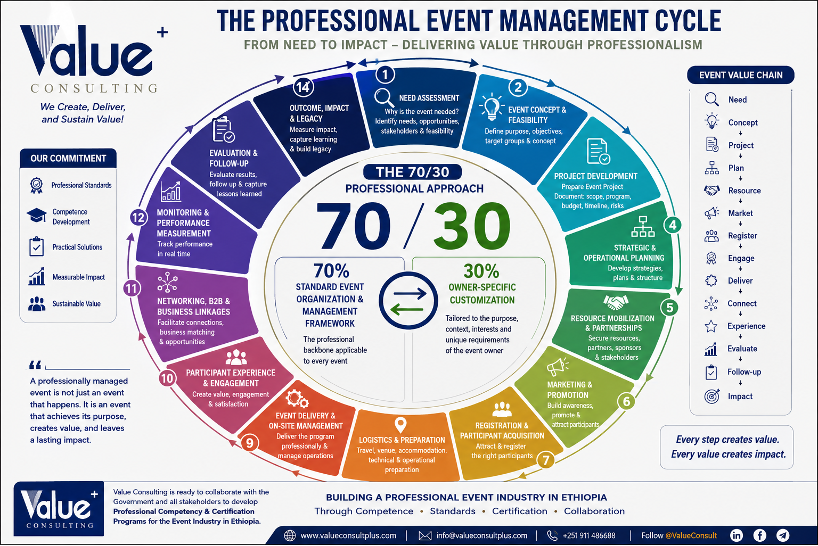
THE 70/30 PROFESSIONAL EVENT MANAGEMENT APPROACH
[70% Standard Event Organization & Management Framework + 30% Owner-Specific Customization]
A professional event should neither be developed entirely from scratch nor managed through a purely standardized formula. It should be built on a recognized professional framework and systematically customized to the specific purpose, requirements, context, and interests of the event owner.
This is the fundamental principle of the 70/30 Professional Event Management Approach. The 70% represents the Standard Event Organization and Management Framework—the professional backbone that should apply, with appropriate adaptation, to every event regardless of its type, scale, location, or purpose. It should encompass the essential stages and functions of professional event management, from Need Assessment and Feasibility through Event Project Development, Planning, Resource Mobilization, Marketing, Registration, Logistics, Operations, Risk and Safety, Participant Experience, Event Delivery, Monitoring, Evaluation, Follow-up, and Impact Assessment.
The 30% represents Owner-Specific Customization. It should respond to the particular interests and requirements of the event owner, including the event’s strategic purpose, target market, sector, theme, scale, budget, institutional priorities, geographical and cultural context, stakeholder environment, and expected outcomes.
Thus: 70% = Professional Standardization
30% = Owner-Specific Customization
The 70/30 principle is not intended to make every event identical. Rather, it establishes a professional common foundation while allowing sufficient flexibility to make every event fit for purpose. It provides a practical balance between standardization and customization, professional consistency and owner requirements, international good practice and local context.
FROM “ORGANIZING AN EVENT” TO “PROFESSIONALLY MANAGING AN EVENT”
An event may take place successfully without necessarily being professionally organized or managed. A venue may be booked, invitations distributed, speakers confirmed, logistics arranged, participants welcomed, and the program completed. Yet these activities alone do not demonstrate that an event has been professionally developed and managed.
A professional event begins much earlier than the opening ceremony—and continues well beyond the closing session. It begins by asking: Why is this event needed? What is it intended to achieve? For whom is it being developed? What value should it create? And how will that value be measured?This distinction is fundamental to the development of a professional event industry in Ethiopia.
PROFESSIONAL EVENT MANAGEMENT BEGINS WITH NEED ASSESSMENT
Like other professional project-development disciplines, event management should not begin with logistics. It should begin with Need Assessment. The first professional question should be: Why should this event be organized?
A proper Need Assessment should examine the problem, opportunity, or strategic requirement behind the event; identify target participants and stakeholders; assess market demand; establish expected outcomes; consider feasibility and risks; identify potential partners and resources; and determine whether an event is actually the most appropriate intervention.
This changes the starting point from: “We have an event to organize.” to: “We have a need, opportunity, or objective that may require an event-based intervention.” That is a fundamentally different professional approach.
FROM NEED ASSESSMENT TO AN EVENT PROJECT DOCUMENT
The findings of the Need Assessment should provide the foundation for a structured Event Project Document. The document should establish the: Purpose → Objectives → Target Groups → Concept → Scope → Business Model → Program → Stakeholders → Resources → Budget → Timeline → Risk → Communication → Implementation → Monitoring → Evaluation → Expected Impact
The Event Project Document should become the principal reference for planning, implementation, coordination, monitoring, accountability, and evaluation. An event should be developed as a project before it is organized as an activity. The 70/30 framework should then be applied to the project: the standard professional framework forms the backbone, while the owner-specific requirements shape the customized component.
THE EVENT ORGANIZATION LANDSCAPE IN ETHIOPIA
Ethiopia’s events are organized through several institutional and operational arrangements. These include:
- Licensed Event Organizers: Companies and organizations licensed to provide event-related services constitute an important part of the professional event ecosystem. However, holding a business or operating license should not automatically be equated with comprehensive professional competence in event management. A license provides legal authorization to operate. Professional competence requires something more: appropriate knowledge, skills, systems, experience, standards, ethics, accountability, and demonstrated performance.
- Governmental and Non-Governmental Organizations: Government institutions, NGOs, associations, development organizations, and other institutions frequently establish ad-hoc organizing committees for conferences, workshops, exhibitions, forums, ceremonies, and other events. Such committees can provide institutional ownership and mobilize internal expertise. However, they are generally temporary structures, and their members may not necessarily possess specialized competencies in event project development, event operations, risk management, participant experience, sponsorship, exhibition management, technology, or post-event impact measurement. Consequently: an event can be institutionally organized without being professionally event-managed.
- Joint Organization and Partnership Models: Another model involves licensed event organizers working jointly with government institutions, chambers of commerce, associations, NGOs, private companies, and other stakeholders. This approach can combine: Institutional Ownership + Professional Expertise + Stakeholder Networks + Resources. But it requires clearly defined roles, responsibilities, deliverables, decision-making authority, professional standards, and accountability mechanisms.
- Complete Outsourcing: Some institutions entirely outsource their events to event organizers. Outsourcing can be an efficient professional model—but only when the client is procuring professional event management rather than merely logistical services. A proper outsourcing arrangement should therefore be supported by a clear Terms of Reference or Scope of Work, defined deliverables, performance indicators, quality standards, risk responsibilities, budget controls, stakeholder-management requirements, and post-event evaluation.
THE CRITICAL QUESTION: WHO IS QUALIFIED TO MANAGE AN EVENT?
This leads to one of the industry’s most important questions: Is business license sufficient evidence of professional competence to organize and manage an event? The question deserves serious consideration as Ethiopia seeks to strengthen its event and MICE industry.
Licensing and professional certification are not the same thing. A license establishes the legal right to operate. Professional certification provides evidence that an individual or organization has demonstrated defined competencies against an established professional framework.
For an industry increasingly involved in conferences, exhibitions, trade fairs, business forums, investment events, diplomatic functions, corporate events, cultural events, and international MICE activities, professional competency should become an integral part of industry development.
The issue, therefore, is not simply how many event organizers are licensed, but whether Ethiopia has an effective system for developing, recognizing, certifying, and continuously improving professional event-management competence.
THE EVENT VALUE CHAIN MUST BE SYSTEMATIZED
Professional event management also requires a clear understanding of the entire event value chain. An event does not begin when participants arrive at a venue, and it does not end when the closing ceremony is completed. The professional value chain should extend from the initial need to the eventual impact:
THE EVENT VALUE-CREATION CHAIN
| No. | Professional Stage | Key Activities / Focus | Value Created |
| 1 | Need Assessment | Identify needs, opportunities, problems, target groups and feasibility | Clear rationale and strategic direction |
| 2 | Event Concept & Feasibility | Define purpose, objectives, theme, format, scope and viability | A clear and feasible event concept |
| 3 | Project Development | Prepare Event Project Document, budget, schedule, governance and implementation framework | A structured and manageable event project |
| 4 | Strategic & Operational Planning | Develop strategies, programs, work plans, responsibilities and operational systems | Organizational readiness and execution clarity |
| 5 | Resource Mobilization & Partnerships | Mobilize funding, sponsors, partners, suppliers and stakeholders | Resources, collaboration and shared value |
| 6 | Marketing & Promotion | Position, promote and communicate the event to target audiences | Awareness, interest and demand |
| 7 | Registration & Participant Acquisition | Attract, register, qualify and manage participants | Relevant and engaged participation |
| 8 | Travel, Accommodation & Logistics | Manage travel, accommodation, transportation, transfers and related services | Convenience, accessibility and operational efficiency |
| 9 | Venue, Program & Technical Preparation | Prepare venue, facilities, program, speakers, exhibitors, technology and technical systems | Event readiness and quality assurance |
| 10 | Event Delivery & On-Site Management | Coordinate operations, program delivery, suppliers, protocols, safety and contingencies | Professional execution and controlled delivery |
| 11 | Participant Experience & Engagement | Manage interactions, service quality, networking and participant satisfaction | Experience, engagement and satisfaction |
| 12 | Networking, B2B & Business Linkages | Facilitate meetings, matchmaking, connections, partnerships and opportunities | Business relationships and market linkages |
| 13 | Monitoring & Performance Measurement | Track KPIs, participation, quality, financial performance and outcomes | Evidence-based performance information |
| 14 | Post-Event Follow-Up | Maintain relationships, follow up leads, commitments, partnerships and opportunities | Continuity and conversion of opportunities |
| 15 | Outcome & Impact Assessment | Measure achievement, economic, institutional, professional and social impact | Measurable results and accountability |
| 16 | Learning, Improvement & Legacy | Capture lessons, improve future events and establish lasting benefits | Continuous improvement and sustainable legacy |
FROM ATTENDANCE TO MEASURABLE VALUE
One of the weaknesses in event evaluation is the tendency to measure success primarily through whether the event took place and how many people attended. Attendance is important—but it is only one indicator. A professionally managed event should ask:
- Did it achieve its stated objectives?
- Was the participant experience satisfactory?
- Were the right stakeholders engaged?
- Were meaningful connections created?
- Were business opportunities generated?
- Were sponsors and exhibitors satisfied?
- What knowledge, partnerships, investment, or market linkages resulted?
- What economic, institutional, professional, or social value was created?
- What should be improved next time?
A professional event therefore moves beyond activity measurement toward outcome and impact measurement. A successful event is not simply an event that happens. It is an event that achieves its purpose, delivers a quality experience, creates measurable value, and generates sustainable impact.
FROM LICENSING TO A PROFESSIONAL EVENT INDUSTRY
The transformation of Ethiopia’s event industry should begin with legal authorization, but it should not end there. A license provides the legal basis for operating an event-organizing business; it should be regarded as the starting point of a professional journey rather than conclusive evidence of professional competence.
The next step should therefore be the development of professional competence. Individuals and organizations involved in event management need appropriate knowledge, practical skills, experience, ethical awareness, and the capacity to apply professional event-management principles in real situations.
This should be followed by competency-based certification, through which professional capabilities can be assessed and formally recognized against an established framework. Certification can provide a more meaningful bridge between legal authorization and professional practice, while also creating incentives for continuous professional development.
Once competence is established and recognized, the industry can progressively move toward standardized professional practice. Recognized procedures, quality requirements, safety and risk-management practices, professional ethics, documentation, technology, stakeholder management, and internationally aligned approaches can provide a common foundation for event delivery—while the 30% owner-specific component allows each event to retain its unique purpose and identity.
Professional practice should then lead to stronger quality and accountability. Event owners, clients, participants, exhibitors, sponsors, partners, and other stakeholders should be able to understand what professional standards are expected and how event organizers are accountable for delivering them.
The next stage is performance measurement. Events should increasingly be evaluated not merely by whether they were conducted or how many people attended, but by whether they achieved their objectives, delivered quality experiences, generated business and institutional linkages, satisfied stakeholders, and created measurable economic, professional, social, or strategic value.
Ultimately, these interconnected steps can lead to the development of a Professional Event Industry in Ethiopia—an industry in which legal authorization is complemented by professional competence, certification, standardized practice, quality assurance, accountability, and measurable performance. The objective is not simply to regulate who can organize an event. It is to establish a professional system that ensures events are competently developed, professionally managed, properly evaluated, and capable of creating measurable and sustainable value.
This narrative also connects naturally to the article’s proposed 70/30 Professional Event Management Approach: professional standards provide the common foundation, while owner-specific customization ensures relevance and purpose.
THE WAY FORWARD: BUILDING A PROFESSIONAL EVENT INDUSTRY
The challenge facing Ethiopia is therefore not simply a shortage of people who can organize events. The deeper challenge is the need to establish event management as a recognized professional discipline and industry. The transformation should be: From Event Organization → to Need Assessment → to Event Project Development → to Professional Event Management → to Measurable Event Value and Impact.
Every event, regardless of its typology, scale, or purpose, should be professionally systematized, managed in accordance with recognized international standards, appropriately customized to its owner and context, and transformed into a value-creating and sustainable enterprise.
VALUE CONSULTING: READY TO CONTRIBUTE TO THE TRANSFORMATION
Value Consulting believes that the professionalization of Ethiopia’s event industry requires collaboration rather than criticism. We are ready to work with the Government, regulatory authorities, professional associations, training institutions, event organizers, chambers of commerce, private-sector stakeholders, and event owners to explore and develop a practical Event Management Professional Competency and Certification Program for Ethiopia.
Such an initiative could establish a common professional foundation for the industry while recognizing the diverse realities of event owners, organizers, and event types. It could provide pathways for competency development, professional certification, continuous professional development, quality assurance, and standards-based practice, aligned with recognized international approaches and adapted to Ethiopia’s institutional and market context.
The objective is not to replace existing event-organizing models, but to professionalize them—to ensure that whoever organizes or manages an event has the competence, systems, standards, and accountability required to deliver quality and measurable value. Are we merely organizing events—or are we building a professional event industry? Value Consulting is ready to be part of that transformation.
UPCOMING PROFESSIONAL TRAINING: CERTIFIED PROFESSIONAL EVENT ORGANIZATION & MANAGEMENT
From Theory to Practice — Building Competence for Professional Event Management
A comprehensive theory-and-practice-based professional training program designed to develop the knowledge, practical skills, tools, and competencies required to professionally develop, organize, manage, deliver, and evaluate events in accordance with recognized professional standards.
The program will cover the complete event management cycle—from Need Assessment and Event Concept Development to Planning, Organization, Delivery, Participant Experience, Business Linkages, Performance Measurement, Evaluation, and Post-Event Impact.
Participants who successfully meet the program requirements will receive a Professional Certificate in Event Organization & Management.
Don’t just learn how to organize an event. Learn how to develop, manage, measure, and deliver it professionally.
JOIN THE PROFESSIONAL EVENT MANAGEMENT JOURNEY
Follow @ValueConsult for the training announcement and registration details.
📞 Mobile: 0911-486688
📧 Email: event.manager.ta@gmail.com/info@valueconsultplus.com
🌐 Website: www.valueconsultplus.com
Value Consulting
We Create, Deliver, and Sustain Value!