
ADDIS ABABA: FROM HISTORIC PAN-AFRICAN PLATFORM TO GLOBAL MICE TOURISM DESTINATION
Turning Evolved Legacy into MICE Tourism Advantage
Addis Ababa’s Greatest MICE Asset Can Be Its Evolved Legacy
What if the greatest MICE asset of Addis Ababa is not simply its conference halls, hotels, airports or event infrastructure? What if it is something much more difficult to build, impossible to import and impossible to reproduce elsewhere?
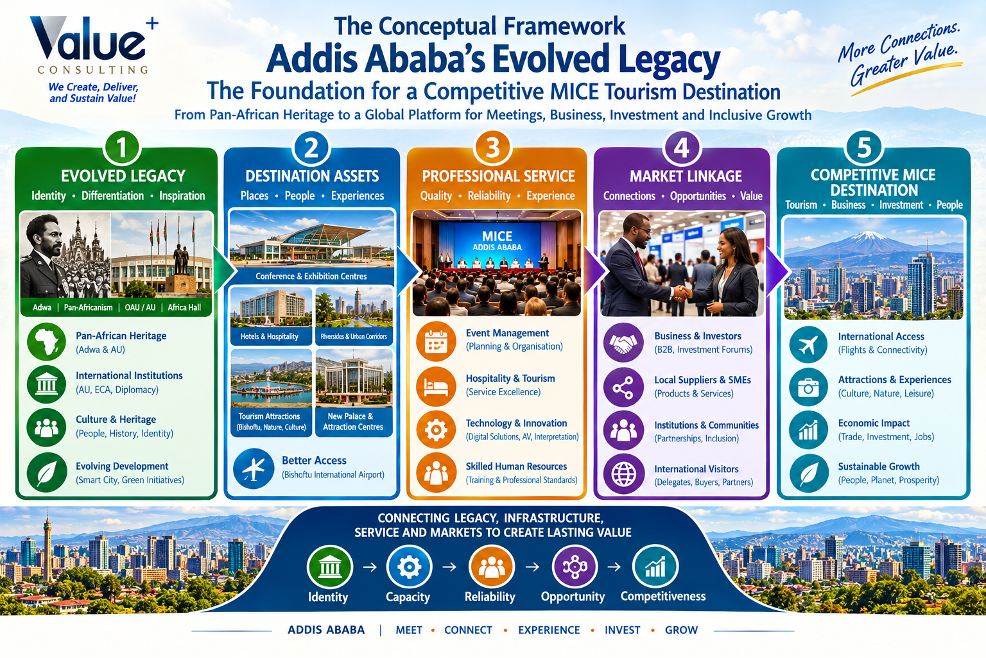
Its Evolved Legacy:
This article advances a proposition that deserves serious examination: the evolved legacy of Addis Ababa can provide the distinctive foundation for the city to become a competitive MICE tourism destination—provided that its growing infrastructure is strengthened, its service gap is bridged through professionalism, and market linkages are deliberately created and optimized across the MICE ecosystem.
The proposition goes beyond history. Addis Ababa’s legacy certainly begins with its historical and Pan-African significance, but it does not end there. It has evolved through the institutions, relationships, infrastructure, businesses, tourism assets and international connections that have developed around the city over generations. Today, that legacy is being extended by new urban developments, attraction centers, major infrastructure projects, industrial and economic investments, expanding hospitality capacity and aspirations for smarter, greener and more future-oriented development. The opportunity, therefore, is not simply to preserve a remarkable past. It is to convert an evolving legacy into contemporary and future destination value.
This distinction is important because successful MICE destinations compete with much more than physical infrastructure. They compete through accessibility, facilities, professional services, hospitality, safety, technology, destination branding, visitor experience and the ability to create meaningful connections. Increasingly, they also compete through something much less tangible but potentially much more powerful: a distinctive identity.
A destination needs a reason for people to come. It needs a story worth experiencing. It needs a proposition that distinguishes it from competing destinations. Addis Ababa possesses such a story.
What Do We Mean by a MICE Destination?
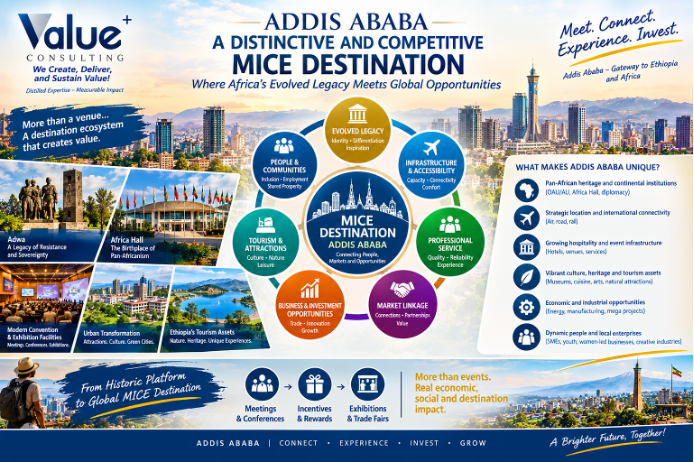
The term “MICE destination” is often used to describe a city or place that attracts and hosts Meetings, Incentives, Conferences and Exhibitions. In professional practice, however, the concept is much broader than the existence of conference halls or the ability to host events. A MICE destination is a place in which the physical infrastructure, accessibility, accommodation, professional services, event facilities, tourism attractions, business environment, institutional support and human capabilities come together to attract, host and serve business-event visitors and create value from their presence.
For the purposes of this article, therefore, a “MICE destination” can be understood as “a geographically defined destination that possesses the infrastructure, accessibility, professional capabilities, hospitality, attractions, institutional environment, business opportunities and market linkages necessary to attract, host and support Meetings, Incentives, Conferences and Exhibitions, while converting the resulting visitor flows and interactions into wider tourism, business, investment, knowledge, employment and destination value.”
This definition is particularly relevant to Addis Ababa because the city should not be viewed merely as a place where meetings take place. Its potential lies in the ability to connect meetings with a much wider ecosystem. A conference can connect delegates with hotels and restaurants, but it can also connect them with Ethiopian businesses, investors, universities, cultural institutions, industrial enterprises, tourism attractions, government institutions and local communities. An exhibition can connect producers with buyers. An investment forum can connect capital with opportunities. A diplomatic meeting can connect institutions with cooperation. A professional conference can connect knowledge with people and ideas with partnerships.
In this sense, “a MICE destination is not simply a place that hosts events; it is a platform that converts events into relationships, relationships into opportunities, and opportunities into sustainable destination value.”
This distinction is critical to Addis Ababa’s emerging proposition. The city should not aspire merely to become a place where the world can hold meetings. It should aspire to become a place where the world can “meet, connect, experience, invest, learn, do business and return”. That is why the concept of a MICE destination extends beyond the event venue.
The airport provides access. Hotels provide accommodation. Convention and exhibition facilities provide the physical platform. Professional event organizations provide reliability. Technology and logistics enable delivery. Tourism attractions create experience. Businesses create economic opportunities. Institutions create networks. Industrial and development projects create substance for business engagement. Local enterprises provide products and services. Market linkages connect all these elements. The destination therefore becomes a “system of interconnected assets, capabilities, people and opportunities”.
For Addis Ababa, this system is particularly distinctive because it can combine the city’s evolved Pan-African legacy, continental institutions, diplomatic presence, Ethiopian culture and heritage, expanding hospitality and MICE infrastructure, emerging attraction centers, national development projects, industrial and investment opportunities and wider tourism assets across Ethiopia.
Consequently, our proposition is not simply that Addis Ababa can host MICE events. It is that “Addis Ababa can develop into a distinctive MICE destination by connecting its evolved legacy with infrastructure, professional service, market linkage and strategic coordination—and by using the city as a gateway to Ethiopia’s wider tourism, business, investment and cultural ecosystem.” This is the deeper meaning of “MICE Destination Value”.
When Historical Legacy Becomes a Destination Asset
In May 1963, African Heads of State and Government gathered in Addis Ababa and established the Organization of African Unity. That historic moment gave the city a significance far beyond its role as the capital of Ethiopia. Addis Ababa became a place where African leaders could meet, deliberate, negotiate and collectively imagine the future of the continent.
That identity has continued through the African Union, continental institutions, diplomatic missions and international organizations based in the city.
For MICE tourism, this continuity is highly significant. A modern convention Centre can be constructed. A hotel can be built. An exhibition facility can be expanded. An airport can be modernized. But the historical circumstances that made Addis Ababa a recognized continental meeting platform cannot simply be recreated elsewhere. This is where history becomes an asset.
History provides identity. Identity can create differentiation. Differentiation can create destination appeal. Destination appeal can attract visitors and events. Properly managed MICE activity can then connect those visitors and events with tourism, business, investment, culture, knowledge and local enterprise.
But history does not automatically produce competitiveness. History creates potential. professionalism and strategic connectivity determine whether that potential becomes value.
From Adwa to Pan-Africanism
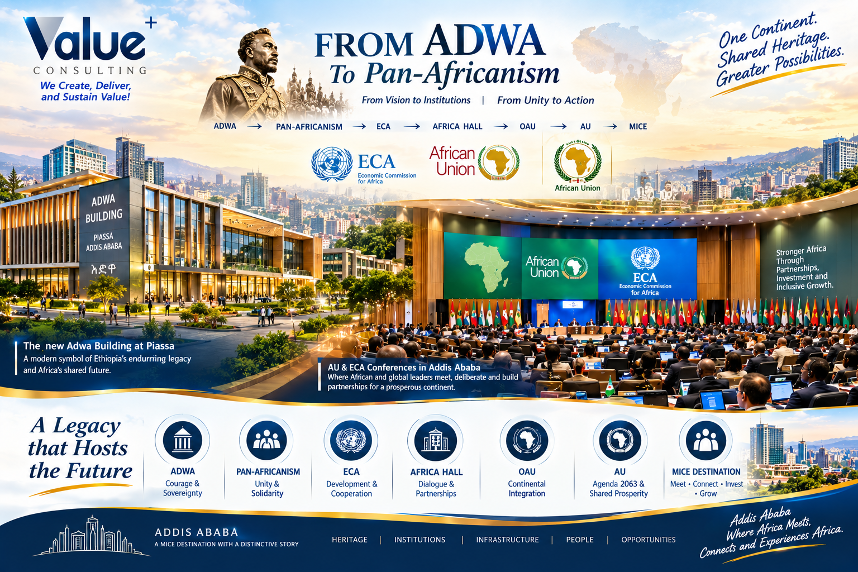
Pan-Africanism: Pan (πᾶν) from Greek, means “all,” “every,” or “the whole.” The word itself tells part of the story. African refers to Africa and its peoples; and -ism denotes a movement or body of thought. Pan-Africanism therefore embodies an idea of African unity, solidarity and common purpose. Addis Ababa became one of the most important physical stages on which that idea moved from intellectual aspiration to continental institution. Pan-Africanism can therefore be understood etymologically as: A movement or body of thought concerned with the unity, solidarity and common interests of African peoples and people of African descent. The important point is that “Pan” does not simply mean “all African countries. It conveys a broader idea of collective African identity, solidarity and common purpose, including the African diaspora.
The Pan-African dimension of Addis Ababa’s identity can also be understood within the wider Ethiopian and African historical narrative.
The Battle of Adwa occupies a powerful place in African history. It represents resistance, sovereignty, African agency and a historic challenge to colonial domination. Its significance therefore extends beyond Ethiopia and contributes to a broader narrative of African self-determination.
When that history is considered alongside Addis Ababa’s role in Pan-Africanism, the establishment of the OAU, the continuing role of the AU and the city’s diplomatic and international institutional presence, an extraordinary narrative begins to emerge.
The story moves from Adwa to Pan-Africanism, from Pan-Africanism to continental institution-building, and from institution-building to today’s Africa and its aspirations for the future.
This narrative has potential tourism and MICE value because contemporary visitors increasingly seek experiences rather than simply locations.
An international conference on African development, diplomacy, leadership, investment, history or international relations could therefore connect its contemporary program with carefully designed experiences of Ethiopia’s and Africa’s historical journey. The purpose would not be to commercialize history superficially. It would be to interpret history in ways that make it accessible, meaningful and relevant to contemporary visitors. In this sense, heritage can become experience, and experience can become destination value.
Africa Hall: Where the Proposition Becomes Visible
Perhaps nowhere is this proposition more tangible than Africa Hall. Africa Hall is deeply associated with the institutional history of African cooperation and the establishment of the OAU. It provides a physical connection between Addis Ababa and the historic moment when African leaders gathered to shape the institutional future of the continent. That gives the city an opportunity that few destinations can reproduce.
A historic site can become a learning environment. A learning environment can become a visitor experience. A visitor experience can become part of a conference program. And a conference program can become part of a wider destination proposition.
Imagine an international conference whose delegates do not simply move between an airport, hotel and conference venue. Imagine delegates being introduced to Africa Hall, Ethiopian history, Pan-Africanism, Ethiopian cuisine, culture, creative industries and business opportunities as interconnected parts of their experience.
The conference would then become more than an event. The destination would become part of the conference, and the conference would become part of the destination. This is the transformation Addis Ababa should consider: not simply preserving historic assets, but connecting them intelligently with contemporary MICE activities to create distinctive, meaningful and measurable destination value.
MICE Is More Than Meetings
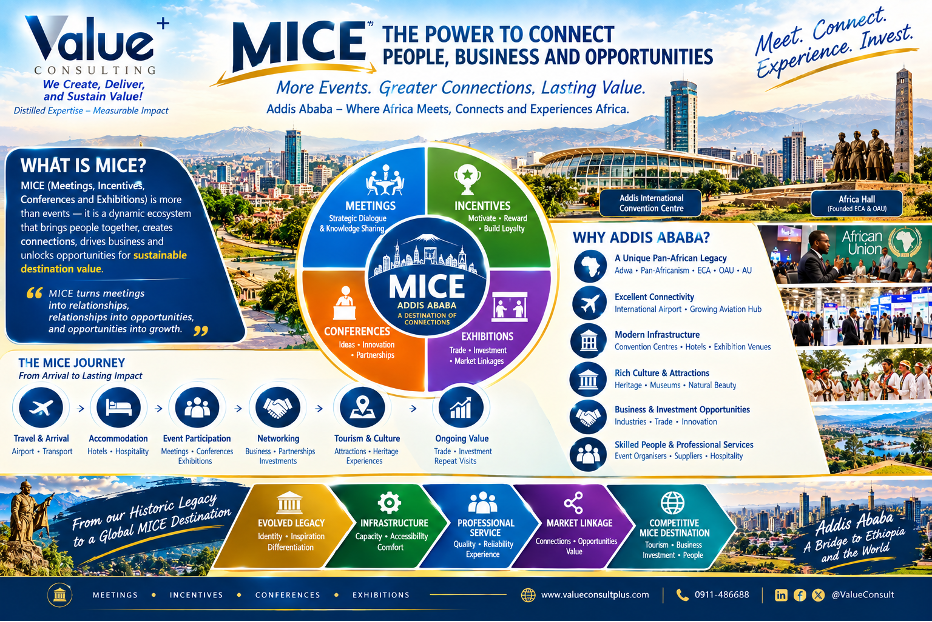
The term MICE—Meetings, Incentives, Conferences and Exhibitions—is sometimes treated as simply another name for organized events. Such an interpretation is too narrow. MICE is better understood as an economic, tourism and relationship-building ecosystem in which an event becomes a gateway to a much wider range of interactions and opportunities.
Consider the journey of an international conference participant. The journey begins before the conference itself, with travel arrangements and an international flight. It continues through arrival, transport, accommodation, meals, conference participation and networking. The participant may then visit a heritage site, experience Ethiopian culture, purchase local products, meet entrepreneurs, explore investment opportunities or extend the visit for tourism.
A single event can therefore stimulate activity across a much wider chain of the economy. The event brings people together, but the economic and social value of their presence can continue through accommodation, hospitality, mobility, tourism, networking, business relationships, market connections, investment opportunities and future visits. This is why MICE tourism should be viewed as part of a destination development strategy, rather than merely as an activity within the event sector.
For Addis Ababa, the strategic question is therefore not simply how many meetings, conferences or exhibitions the city can host. The more important question is what happens because those people came together.
From Attendance to Value
One of the most important changes in thinking should be a movement away from measuring MICE success primarily through attendance. A large event is not necessarily a high-value event. Thousands of people can attend a conference without generating significant business opportunities for the local economy, while a smaller and more targeted event can create considerable value if it brings together the right buyers, investors, institutions, professionals and decision-makers.
The important question is therefore not simply how many people attended, but what happened because they met. An exhibition can connect Ethiopian producers with international buyers. A conference can connect researchers with institutions. An investment forum can connect capital with entrepreneurs. A diplomatic meeting can create opportunities for cooperation. A professional association meeting can generate knowledge partnerships. A cultural program can introduce international visitors to Ethiopian creative industries. In each case, the event creates the platform, but the connections created through that platform are where much of the value begins.
This changes the way MICE performance should be understood. Meaningful business meetings, buyer–producer connections, investment leads, partnerships, local supplier participation, tourism expenditure, visitor nights, repeat visits and future events can all tell us more about the value of a MICE destination than attendance figures alone. The objective should therefore not simply be to attract more events. It should be to create more value from every event.
The City Itself Becomes Part of the MICE Experience
A MICE visitor does not experience a destination inside a conference hall alone. The experience begins at the airport and continues through transport, hotels, restaurants, public spaces, cultural sites, attraction centers, shopping areas, business districts and the quality of interaction with people. This is why the transformation taking place in Addis Ababa matters to the MICE argument.
The development of new attraction centers, urban corridors, riverside spaces, hospitality facilities and other visitor-oriented developments can strengthen the city’s ability to provide experiences beyond the formal event.
The new palace and other emerging landmark developments can also contribute to the city’s evolving identity and visitor proposition when appropriately integrated into tourism and destination experiences.
These developments should not be viewed simply as physical construction or urban beautification. They can become part of a broader process of destination-making.
A delegate may attend a conference during the day, participate in business meetings in the afternoon, experience a cultural or attraction Centre later in the day and continue networking over dinner.
The city itself becomes part of the program. This creates an important distinction: a MICE destination does not simply provide places to meet; it provides reasons to stay, experience, connect and return.
Ethiopia’s Mega Projects: From Development Assets to MICE Opportunities
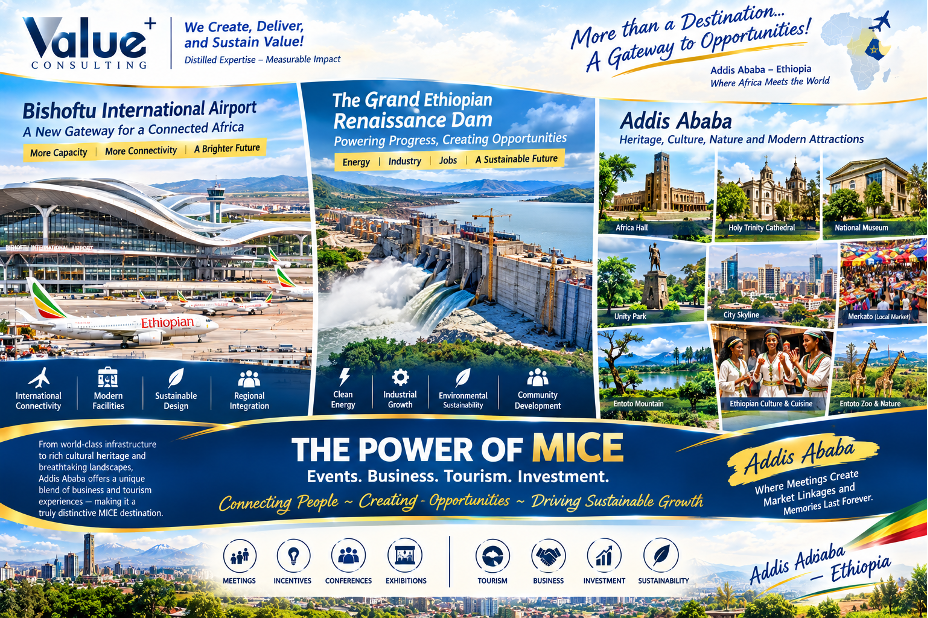
The evolving legacy of Addis Ababa must also be understood within the context of Ethiopia’s wider transformation. Major national development projects such as the Grand Ethiopian Renaissance Dam, emerging aviation infrastructure, energy investments, industrial development and other large-scale projects can create opportunities extending well beyond their immediate economic purposes.
The Grand Ethiopian Renaissance Dam, for example, is not simply an energy project. It has become a powerful symbol of Ethiopia’s development aspirations and is increasingly associated with tourism and visitor experiences around the reservoir and surrounding landscape.
The strategic question is therefore not whether a dam is a MICE attraction in itself. Rather, it is whether a major development project can create reasons for international people, businesses, institutions, investors, researchers and professionals to come to Ethiopia. The answer can potentially be yes.
Major projects can generate international delegations, technical conferences, investment forums, exhibitions, business meetings, knowledge exchanges and site visits. When appropriately developed, such activities can be connected with tourism and cultural experiences.
The same logic applies to emerging aviation infrastructure. The development of Bishoftu International Airport has the potential to strengthen international accessibility and connectivity, and consequently to increase the capacity of the wider Addis Ababa and Ethiopian destination ecosystem.
Infrastructure therefore does more than move people. It can enable new relationships, new markets and new reasons to visit.
Energy and Industry Add Economic Substance to MICE
The MICE opportunity should not be reduced to leisure tourism. Business is at the heart of MICE.
Ethiopia’s emerging energy and industrial developments can create demand for conferences, investment forums, exhibitions, technical meetings, supplier program and business delegations.
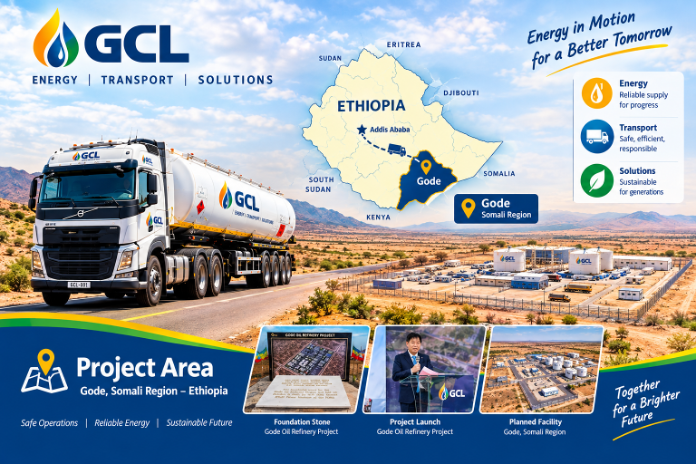
The energy development being undertaken by GCL Ethiopia in Gode provides an example of how a major energy and industrial investment can potentially create new opportunities for international business engagement. Such a project can bring together government institutions, investors, engineers, technology providers, suppliers, financial institutions, researchers, communities and international partners. Those relationships may require meetings, conferences, exhibitions, technical visits and investment forums.
Industrial zones within and outside Addis Ababa add another dimension. They can potentially connect international buyers and investors with Ethiopian manufacturing and production capacity. An international manufacturing event held in Addis Ababa could therefore extend beyond the conference venue. Delegates could participate in an exhibition, engage in B2B meetings, visit industrial facilities, meet Ethiopian producers, explore investment opportunities and experience the country’s tourism and cultural assets. The conference hall would provide the meeting point. The economy would provide the substance. Tourism and Industry Can Meet Through MICE This is where the MICE concept becomes particularly powerful. Tourism and industry are often discussed separately. MICE can connect them.
The Conversation Must Now Move from Events to Destination Value
The MICE perspective presented in this article reinforces a broader principle of destination development: Value is created not by isolated services, but by the connections among them.
For Addis Ababa, the strategic challenge is therefore to build a MICE ecosystem in which historical identity, institutional strength, hospitality, event professionalism, tourism, business and market linkage work together.
The opportunity is not merely to attract more delegates, but to create more value from every delegate. It is not merely to host more events, but to create better-connected events. It is not merely to increase visitor numbers, but to strengthen the connections between visitors and the local economy. And it is not merely to preserve heritage, but to transform heritage into meaningful experience, knowledge, identity and economic opportunity.
This is where MICE Tourism, Market Linkage and Professional Event Management converge. And this is where the future of Addis Ababa as a distinctive global MICE tourism destination may ultimately be decided.
The proposition with which we began therefore remains open—but increasingly compelling: Addis Ababa’s greatest MICE asset can be its historical legacy. The challenge is now to determine how that legacy can be transformed into measurable contemporary value. The conversation should now move from events to destination value.
Who Benefits?
This question should be at the Centre of any serious MICE strategy. Who benefits when an international conference takes place in Addis Ababa? The answer should extend well beyond the conference venue and the event organizer to include the wider network of businesses, institutions, professionals and communities that make up the destination economy.
Hotels should benefit from accommodation demand, transport operators from increased mobility, and tour operators and restaurants from the wider visitor economy. Local suppliers should gain opportunities to provide products and services, while cultural institutions and creative professionals should find new platforms for their work. SMEs and entrepreneurs should gain access to markets, while young people and women-led enterprises should have opportunities to participate in the growing MICE value chain.
The benefits can extend further. Ethiopian producers can encounter new buyers; universities can develop knowledge partnerships; investors can discover new opportunities; and communities can experience economic benefits from the wider tourism ecosystem. In this way, the value generated by an international event can move through multiple layers of the local economy rather than remaining concentrated around the event itself.
But this does not happen automatically. It requires deliberate design, coordination and market linkage. Local enterprises need to know where opportunities exist, have the capacity to meet required standards, and have mechanisms through which they can connect with organizers, buyers, delegates, institutions and other participants in the MICE ecosystem.
This is why MICE tourism, if properly developed, can become more than a tourism product or an event-sector activity. It can become an inclusive market-linkage platform—one that connects international visitors and institutions with local businesses, knowledge, culture, products, services and investment opportunities.
The real measure of an inclusive MICE destination is therefore not simply how many people come, but how widely the value created by their presence is connected to the destination and its people.
Market Linkage: The Missing Connection
Market linkage deserves particular attention because MICE tourism involves many actors whose products and services must work together to create a coherent destination experience. A visitor does not experience a destination through one organization alone. The experience is co-created by hotels, venues, airlines, transport operators, event organizers, tour operators, catering companies, technology providers, restaurants, cultural institutions, government agencies and numerous other suppliers.
The strength of a destination therefore depends not only on the quality of individual organisations, but also on the quality of the relationships among them. For Addis Ababa, market linkage should not be understood simply as a commercial transaction. It should be understood as a system of coordination and value exchange through which different actors connect their capabilities, respond to market demand and create value together.
Strong linkages can improve market responsiveness, support joint product development, facilitate business relationships and help retain a greater share of tourism and event expenditure within the local economy. Weak linkages, by contrast, can produce fragmentation, duplication, poor service integration and economic leakage.
This is why market linkage is not merely a supporting detail of MICE tourism. It is one of its central operating mechanisms.
From Insight to Professional Practice
If Ethiopia is to move from an event industry that merely delivers activities to a professional MICE industry that creates sustainable destination value, people and organizations must be equipped with the knowledge, skills and professional standards to lead that transformation. Value Consulting therefore invites interested professionals, aspiring event practitioners, organizations and corporate teams to join its professional training programs in Event Organization & Management, MICE, and related areas of value creation. Whether you are seeking to strengthen your individual professional competence or build the capacity of your organization, this is an opportunity to turn knowledge into practice, practice into professionalism, and professionalism into measurable value.
Join Value Consulting and become part of the movement to professionalize Ethiopia’s event and MICE industry.
VALUE CONSULTING
We Create, Deliver, and Sustain Value!
Distilled Expertise – Measurable Impact
📞 Mobile: 0911-486688
🌐 Website: www.valueconsultplus.com
📱 Social Media: @ValueConsult